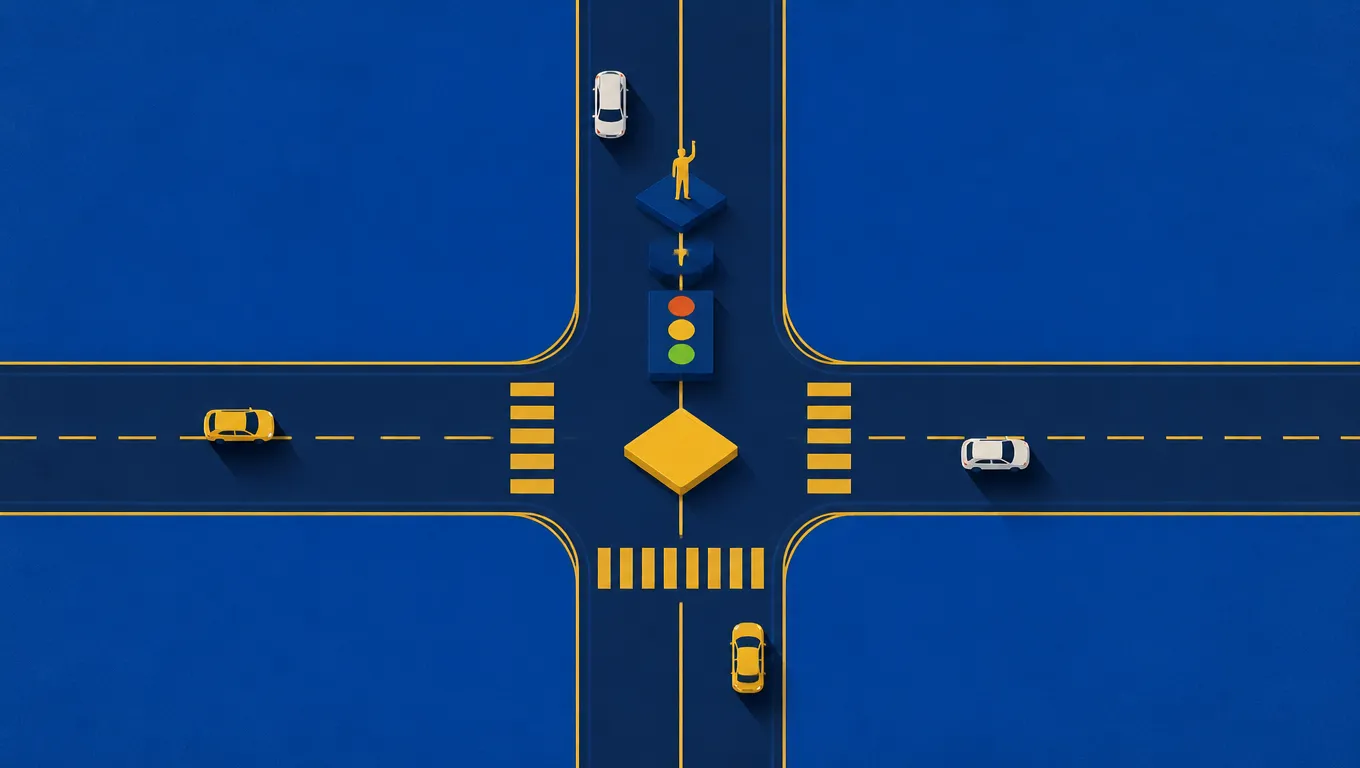
The German right-of-way rules (Vorfahrtsregeln) have a fixed ranking. A police officer’s signals beat traffic lights. Traffic lights beat priority signs. Signs beat right before left. When two of them seem to disagree at a junction, you follow the higher one and ignore the lower one.
The ranking of the Vorfahrtsregeln
| Rank | What decides | German term |
|---|---|---|
| 1 | Police officer directing traffic | Zeichen und Weisungen der Polizei |
| 2 | Traffic lights | Lichtzeichen (Ampel) |
| 3 | Priority signs | Vorfahrtzeichen |
| 4 | Right before left | rechts vor links |
Work from the top. Is an officer directing traffic? Then nothing else counts. No officer, but working lights? Follow the lights. No lights, or lights switched off? Read the signs. No signs at all? Then the vehicle from the right goes first.
Level 1: the police officer
An officer’s signals override lights and signs. If the light shows green and the officer shows you their chest, you stop. If the light is red and the officer waves you through, you drive, with care.
The three stances are quick to learn: chest or back towards you means stop, side towards you means go, one arm raised means wait. They are explained in police hand signals.
Level 2: traffic lights
Working lights beat every sign at the junction. At a green light you drive past a stop sign without stopping. The sign only comes back into force when the lights are off.
Two details matter here:
- Lights off or flashing yellow. A flashing yellow light only warns. It gives nobody priority. In both cases the signs decide.
- Green does not protect a left turn. With a plain round green, oncoming traffic still goes first when you turn left. Only a lit green arrow in the light gives your direction a protected phase.
The small painted green arrow plate beside a red light is a special case. It lets you turn right on red after a full stop. See grüner Pfeil.
Level 3: the priority signs
Four signs set the priority:
| Sign | Meaning |
|---|---|
| White triangle with red border, point down (Vorfahrt gewähren) | Give way to the other road. You may roll on if it is clear. |
| Red octagon (Stop) | Stop completely at the line, every time, then give way. |
| Yellow diamond (Vorfahrtsstraße) | Priority road. You go first at every junction until the sign is cancelled or you meet a yield or stop sign. |
| Red triangle with a thick arrow | Priority at the next junction only. |
Where a priority road bends, a small plate under the sign shows its course with a thick line. If you follow the bend, you signal, because you are changing direction.
Signs replace right before left completely. At a junction with a yield sign, it is irrelevant who comes from the right. The two give-way signs are compared in Vorfahrt gewähren and the stop sign.
Level 4: right before left
Only if nothing above applies does the basic rule decide: the vehicle from your right goes first. Road width and arrival order play no part. The full rule and its exceptions are in rechts vor links.
Rules that sit beside the ranking
Some rules apply on top of the ranking, whatever level decided the junction.
Turning left. Oncoming traffic that goes straight on or turns right goes first. This holds when you both have green and when you are both on the priority road. Two oncoming left-turners normally turn in front of each other.
People on foot and on bikes when you turn. Cyclists riding straight on beside you go first. So do pedestrians crossing the road you turn into. Your priority road does not beat them.
Blue light with siren. An emergency vehicle using both gets a free path at once, even if you have green or priority.
Leaving side places. From a driveway, across a lowered kerb, from a field track, or out of a traffic-calmed zone or pedestrian zone you wait for everyone. Right before left does not help you there.
Blocked junctions. If traffic is stuck beyond the junction, you may not drive into it, even with green or priority. Wait before it so the crossing road stays clear.
Giving up priority. The law requires whoever has priority to give it up when the traffic situation demands it. If another driver has clearly not seen you, you brake.
A worked example
You reach a crossroads. A traffic light hangs over it, a stop sign stands beside your lane, and a car approaches from the right.
- The light shows green: you drive. The stop sign and the car from the right do not count. The other car has red.
- The light is switched off at night: the stop sign counts. You stop completely and give way to the car on the crossing road.
- An officer stands in the junction with their chest towards you while your light is green: you stop.
What a priority offence costs
As of November 2026, ADAC lists 25 euros for ignoring priority and hindering the other driver, 100 euros and one point for endangering them, and 120 euros and one point if an accident follows. Driving through a stop sign without stopping is listed at 10 euros, and at 70 euros and one point with endangerment.
Common mistakes
- “There is a stop sign, so I stop even at green.” Lights beat signs. At green you drive on.
- “The lights are off, so right before left applies.” First read the signs. Right before left only applies if there are none.
- “Flashing yellow means I may go first.” It only warns of danger. The signs decide.
- “I have priority, so I can rely on it.” Priority is not a right to crash. Give it up when that prevents danger.
- “The triangle with the arrow makes my road a priority road.” It covers the next junction only. The yellow diamond covers the whole road.
How to remember it
People, lamps, plates, hands: officer, lights, signs, right hand. The higher one always wins.
At every junction, ask the four questions in that order and stop at the first “yes”.