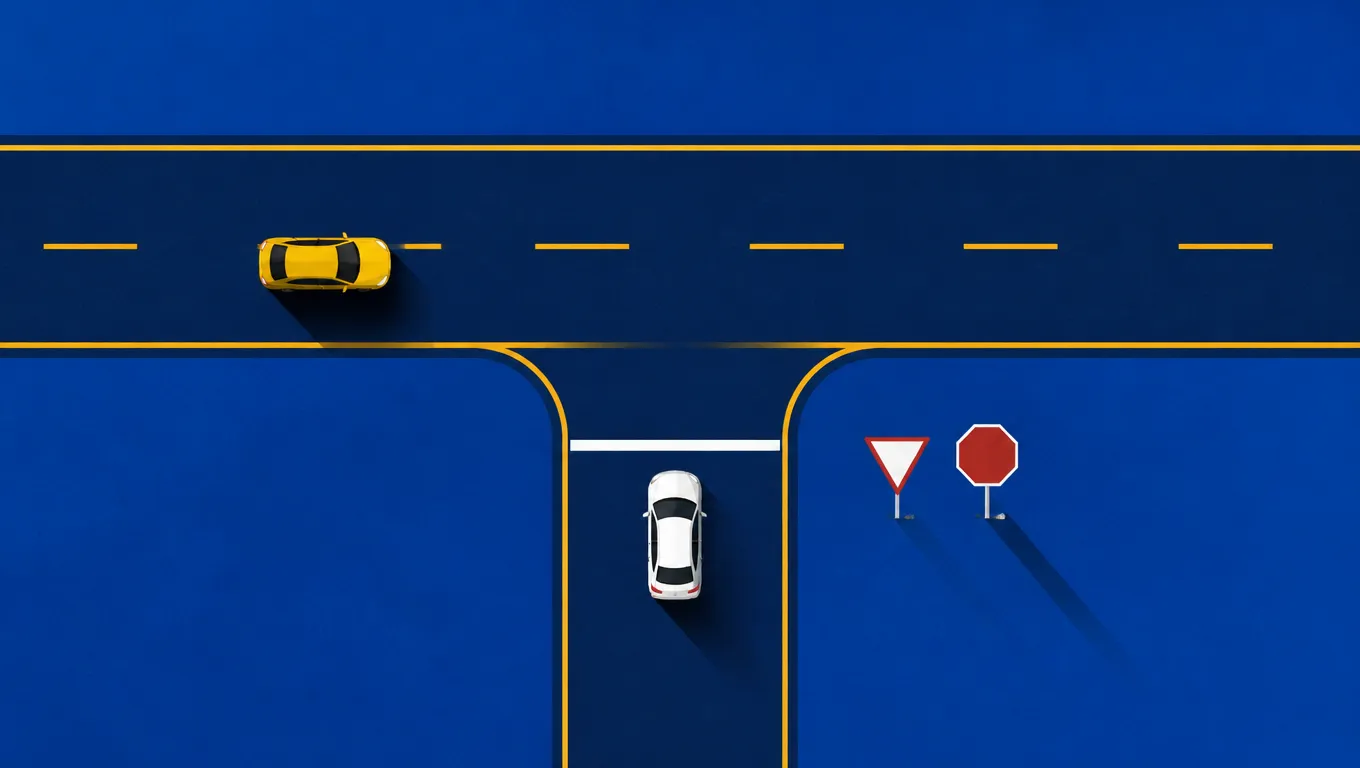
Both signs tell you that traffic on the other road goes first. The give-way sign (Vorfahrt gewähren Schild), a white triangle with a red border standing on its tip, lets you continue without stopping if the road is clear. The stop sign, a red octagon, makes you stop completely every time, even when you can see that nothing is coming.
What the Vorfahrt gewähren Schild requires
The triangle means: give way. Traffic on the road you are joining or crossing has priority, from the left and from the right.
You do not have to stop. You do have to approach in a way that shows you will wait. Slow down early, so that you could stop. Drive on only when you can see that you will neither endanger nor seriously hinder anyone who has priority.
If the view is poor, you may creep forward into the junction until you can see.
Stopping on a clearly empty road is not required. It only confuses the drivers behind you.
What the stop sign requires
The octagon means: stop and give way (Halt. Vorfahrt gewähren.). Your wheels must stand still. A slow roll over the line counts as not stopping.
Then the same duty applies as at the triangle: you go when the other road is free.
As of November 2026 the federal fine catalogue lists 10 euros for not obeying the stop sign and 70 euros if you endanger someone by it.
Where exactly you stop
- With a stop line (Haltlinie): stop at the line.
- Without a line: stop where you can see along the other road.
Sometimes the view from the stop line is blocked, for example by a hedge or parked cars. Then you stop at the line first, creep forward to the point where you can see, and stop again if traffic is coming.
You may also not stop or park within 10 m before either sign if your vehicle would hide it from other drivers.
The two signs side by side
| Give-way sign | Stop sign | |
|---|---|---|
| Shape | Triangle on its tip, red border | Red octagon |
| German text | Vorfahrt gewähren | Halt. Vorfahrt gewähren. |
| Must you stop? | Only if someone is coming | Always |
| Others go first? | Yes | Yes |
| Right before left? | Does not apply | Does not apply |
Both signs have a shape that no other sign uses. You can recognise them from behind. That also tells you something about the other road: if you see the back of an octagon facing the side road, drivers there have to wait for you.
A give-way triangle with a plate that says STOP and a distance, such as 100 m, announces a stop sign ahead.
Signs beat right before left, lights beat signs
Where one of these signs stands, right before left is switched off. It does not matter who comes from the right. The other road goes first.
Above the signs there are two more layers:
- A police officer directing traffic beats everything.
- Working traffic lights beat the signs. At green you drive past a stop sign without stopping.
When the lights are off, or only flash yellow, the signs decide again. That is why many junctions with lights also carry a give-way or stop sign. The full ranking is in the order of right-of-way rules.
The matching signs for the other road are the yellow diamond and the red triangle with an arrow. See the priority road sign.
Plates you may see with these signs
- A plate with a thick bent line shows the course of the priority road. The thick line has priority, the thin lines wait.
- A plate with a bicycle and two arrows warns that cyclists cross from the left and from the right.
- A plate with a tram tells you to give way to the tram.
- At a roundabout, the give-way triangle stands above the blue roundabout sign. Traffic in the circle then goes first.
Common mistakes
- “At a stop sign I may roll if the road is empty.” You stop fully, every time. That is the whole difference to the triangle.
- “At the triangle I must always stop.” You may roll on if you can see that it is clear.
- “The car from the right goes first here.” Signs beat right before left. Read the sign first, then look for vehicles.
- “I stop at the stop line and then just go.” If you cannot see from the line, creep forward and be ready to stop a second time.
- “With a green light I still have to stop at the stop sign.” Working lights outrank the sign.
How to remember it
Yield lets you roll. Stop makes you still.
The octagon has eight corners and one job: zero speed. The triangle points down at the road, where you look for the others first.