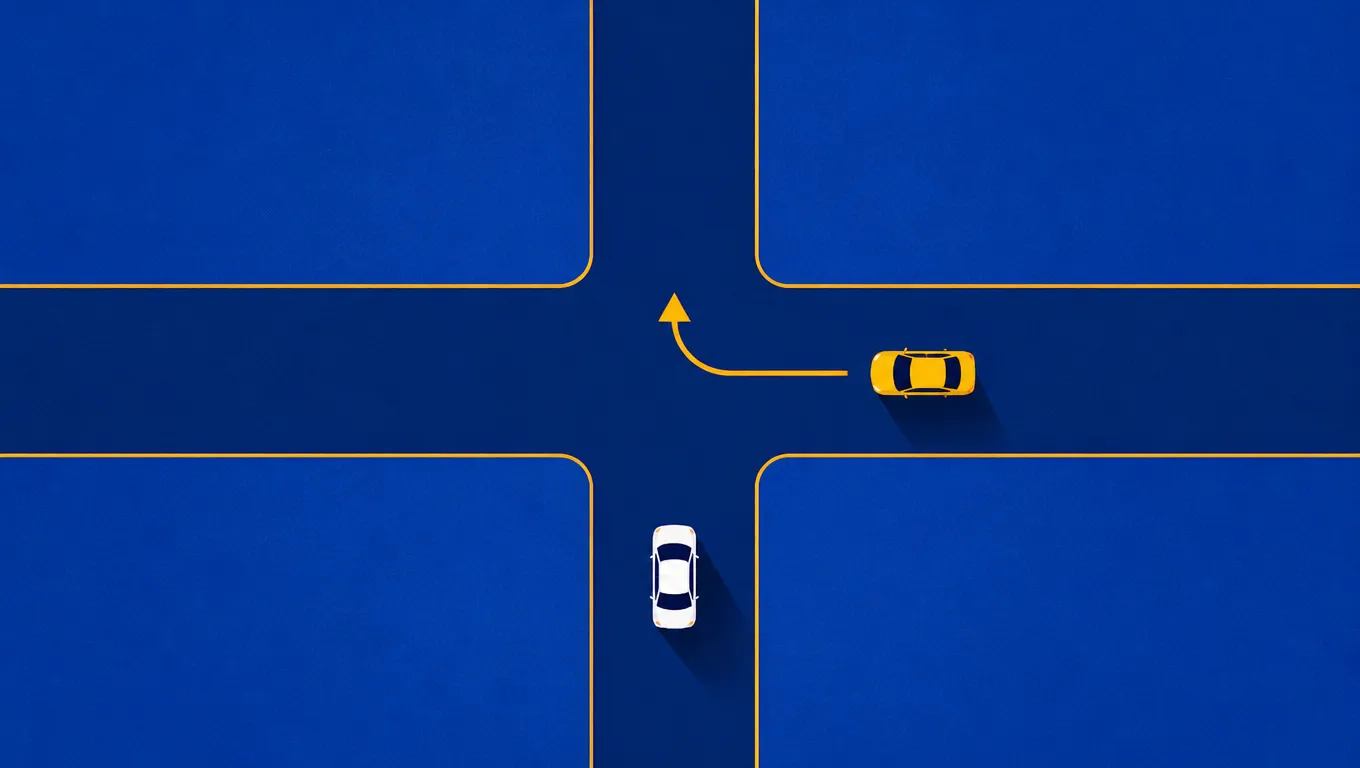
Rechts vor links (right before left) is the German default rule for junctions. Where no sign, no traffic light and no police officer sets the priority, the vehicle coming from your right goes first. It does not matter which road is wider, who arrived first, or who is driving straight on.
Where rechts vor links applies
The rule applies at every crossroads and every T-junction (Kreuzung and Einmündung) that has no priority sign and no working traffic light. You meet such junctions mostly in housing areas. In 30 km/h zones (Tempo-30-Zone) it is the normal case, because these zones are usually built without priority signs.
A red-bordered warning triangle with a black cross announces a junction where right before left applies. It is put up where the junction is hard to see or where the priority was changed recently. The sign does not create the rule. The rule applies without it too.
Only the direction the other vehicle comes from counts. Where the other driver wants to go is irrelevant. If a car comes from your right, it goes before you whether it turns or drives straight across.
Who counts as a vehicle
Every vehicle counts, not only cars:
- A cyclist from the right goes before your car. This is true whether the cyclist rides on the road or arrives on a cycle path.
- Moped riders, e-bike riders and motorcyclists count in the same way.
- In a bicycle street (Fahrradstraße) the rule also applies unless signs say otherwise. More on that in Fahrradstraße rules.
Pedestrians are not vehicles, so right before left does not sort out who goes first between you and a person on foot. Other rules protect them, for example when you turn.
Where the rule does not apply
Right before left ranks lowest of all the priority rules. Anything else beats it:
- Signs. A yield sign, a stop sign or a priority sign replaces the rule completely. See Vorfahrt gewähren and the stop sign.
- Traffic lights and police officers. Both rank above signs.
- Field and forest tracks (Feld- und Waldwege). A vehicle coming out of one waits for traffic on the road, even if it comes from the right.
- Driveways, properties and lowered kerbs. Whoever drives onto the road from a property or across a lowered kerb must not endanger anyone and waits for all traffic. Details in abgesenkter Bordstein.
- Leaving a traffic-calmed zone or a pedestrian zone. Inside a traffic-calmed zone (verkehrsberuhigter Bereich) right before left applies between its streets. When you drive out of the zone you wait for everyone.
- Signed roundabouts. With the blue roundabout sign and a yield sign, traffic in the circle goes first.
Car parks are a grey area. According to ADAC, right before left applies where the lanes are clearly laid out like roads. On open parking areas where the lanes only serve for finding a space, you cannot rely on it. Drive slowly and agree with the other driver.
How to work out the order
With two vehicles the check is quick. Look right. If someone is there, you wait.
With three vehicles, go through them one by one. Ask for each driver: is anyone on this driver’s right? The driver whose right side is free goes first. Then repeat for the vehicles that remain.
A worked example. You come from the south. Car B comes from the east, so it is on your right. Car C comes from the north, opposite you. The west arm is empty. C drives south, so its right hand points west, at the empty road. C goes first. B drives west, so its right hand points north, at C. B waits for C and goes second. Your right hand points east, at B. You go last.
If vehicles arrive from all four sides at once, every driver has someone on the right. By the rule, nobody may go. The drivers have to agree by eye contact or a hand sign. One gives up their turn, and the rest follow in order.
What the driver who waits must do
The law asks the driver who has to give way to show it early, mainly by driving at a moderate speed. You may only drive on when you can see that you will neither endanger nor seriously hinder the vehicle with priority.
If parked cars or a hedge block your view, creep forward slowly until you can see. Do not roll into the junction at speed and hope.
Having priority is not a guarantee either. If the other driver has clearly not seen you, brake and let them go.
What it costs to get it wrong
As of November 2026, ADAC lists these penalties for ignoring right before left: 25 euros for the plain offence, 100 euros and one point if you endanger someone, and 120 euros and one point if it ends in an accident. The larger cost is usually the liability for the crash.
Common mistakes
- “My road is wider, so I have priority.” Road width means nothing. A narrow side street from the right goes before your wide street.
- “I was there first.” Arrival order never decides priority in Germany. Look for signs first, then for who is on the right.
- “I am going straight on, so I go first.” Straight against turning only matters between oncoming vehicles. Otherwise the question is who is on the right.
- “It is only a bike.” A bicycle is a vehicle. A cyclist from the right goes first, exactly like a car.
- “I come from the right, so I can pull out of this driveway.” From a driveway, a lowered kerb, a field track or a traffic-calmed zone you always wait.
How to remember it
Lift your right hand. A vehicle on that side goes before you.
For three or more vehicles, sit in each driver’s seat in your head and lift their right hand. The driver whose right hand points at an empty road starts.