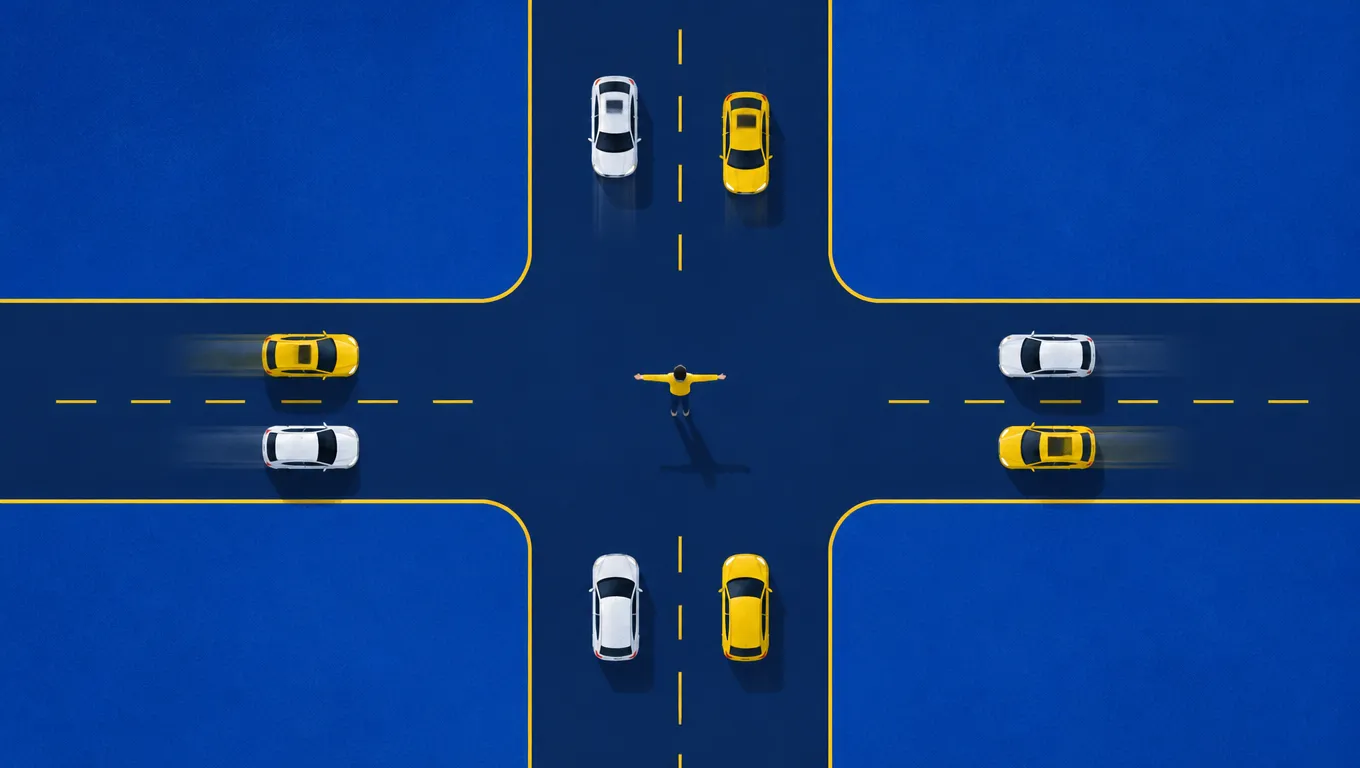
The hand signals of a police officer (Polizist Handzeichen) are read from the way the officer stands. If you see the officer’s chest or back, you stop. If you see the officer’s side, you may go. One arm raised straight up means wait. These signals rank above traffic lights and above every sign.
The three Polizist Handzeichen
| What you see | Meaning | Like a traffic light showing |
|---|---|---|
| Chest or back, arms stretched out sideways across your path | Stop before the junction | Red |
| The officer’s side, arms pointing along your direction | You may drive | Green |
| One arm raised straight up | Wait before the junction for the next signal. If you are already in the junction, clear it. | Yellow |
The law describes the first signal as stretching one or both arms out sideways, across the direction of travel. That stops the traffic the arms block and releases the traffic that crosses it. So the stop and go signals are one and the same stance, seen from two sides. Drivers facing the chest or back are held. Drivers who see the shoulder may go.
The raised arm is the change-over. The officer uses it before turning to release the other road. Nobody new drives in, and whoever is still in the middle of the junction leaves it.
The signal stays valid when the arms come down
An officer cannot hold both arms out for minutes. After giving the signal, the officer may lower the arms. The signal still applies for as long as the officer keeps the same basic stance.
So look at the body, not the hands. Chest or back towards you still means stop, even when the officer stands with arms at the sides. Only when the officer turns or raises an arm does anything change.
Officers beat lights and signs
An officer directing traffic stands at the top of the priority ranking. The order is: officer, traffic lights, signs, right before left. The whole ranking is explained in which right-of-way rule wins.
In practice that produces situations that feel wrong at first:
- Your light is green, but the officer shows you their chest. You stop.
- Your light is red, and the officer stands side-on to you and waves you on. You drive.
- You are on a priority road with the yellow diamond, and the officer’s back is towards you. You stop.
You meet officers directing traffic mostly where the lights have failed, after an accident, or around large events.
One sentence in the law is easy to overlook. Following the officer’s signal does not free you from your own duty of care. If the officer waves you on and a pedestrian is still on the road in front of you, you wait for the pedestrian.
Turning when the officer releases you
When your direction is released, you may also turn. The normal turning rules stay in force:
- Turning left, you let oncoming traffic pass. It has been released at the same time as you.
- Turning left is only allowed if you do not hinder a tram.
- Turning in either direction, you let pedestrians and cyclists go who continue straight on.
Signal as usual. The officer needs to know where you want to go as much as the other drivers do.
Other signals an officer may give
The three stances are the basic set. An officer may add to them or change them with other signals, for example by waving one lane forward, pointing at a single driver, or beckoning traffic to speed up. Such individual instructions also override the general rules. Follow what the officer plainly wants from you.
The same signals are used away from junctions too, for example at pedestrian crossings or where a lane is closed.
Police officers may also stop a vehicle for a traffic check. They signal that with a hand-held stop disc, a red light, or a lit sign on the police car. A police car can also stop you this way from behind. In that case you signal, pull over where it is safe, and follow the instructions.
When a police car comes up behind you with blue light and siren, a different rule applies. See blue light and siren.
What ignoring an officer costs
As of November 2026, the catalogue of fines lists 70 euros for not obeying an officer’s signal or order to stop, and 20 euros for not following another instruction from an officer.
Common mistakes
- “My light is green, so the officer cannot mean me.” The officer outranks the light. Chest or back towards you means stop.
- “The arms are down, so the signal is over.” It stays valid as long as the officer keeps the same stance.
- “Raised arm means go.” It means wait. Only vehicles already in the junction move, to clear it.
- “The officer waved me through, so I need not look.” You still have to take care. Pedestrians and oncoming traffic remain your job.
- “Chest means stop, but the back means go.” Chest and back mean the same. Only the side lets you through.
How to remember it
Chest and back hold you back. Shoulder to you, drive through.
Or picture the officer’s outstretched arms as a barrier. If the barrier lies across your road, you wait. If it lies along your road, it is open.