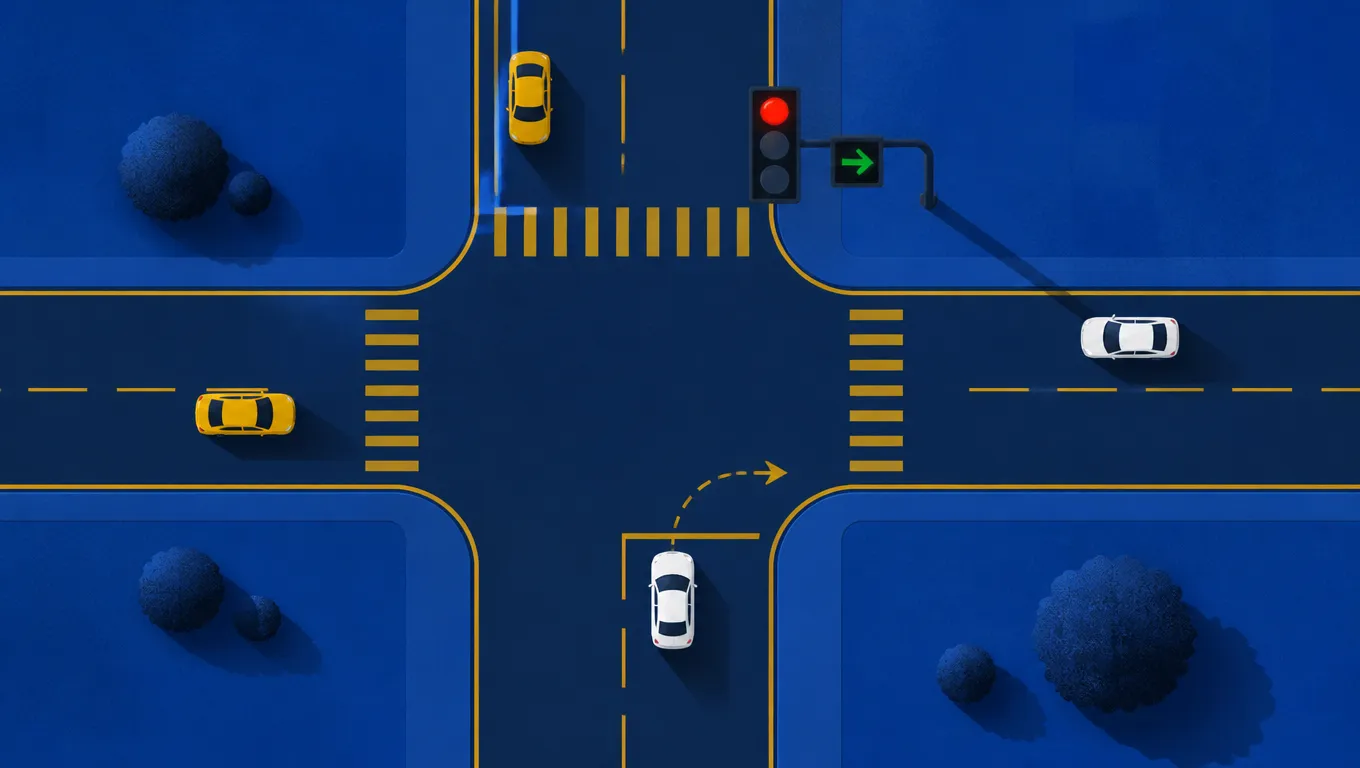
The Grüner Pfeil (green arrow) is a small plate with a green arrow on a black background, fixed beside the red lamp of a traffic light. It lets you turn right while the light is red. Two conditions apply: you must come to a full stop first, and you may only go if you hinder or endanger nobody. There is no general right turn on red in Germany. Without the plate, red means wait.
What the Grüner Pfeil plate allows
The plate is a painted metal sign. It does not light up and it does not change. It hangs to the right of the red lamp and shows an arrow pointing right.
The light is still red for you. The plate only opens an exception for one manoeuvre: turning right. You may not drive straight on or turn left with it.
The law sets these conditions:
- Stop first. You stop completely at the stop line (Haltlinie), as you would at a stop sign. Wheels stand still.
- Hinder and endanger nobody. This covers vehicles on the crossing road, which have green, and above all pedestrians and cyclists who have green across the road you turn into.
- Right lane only. If there are several lanes, you may turn on the arrow only from the right-hand lane.
You are allowed to use the arrow. You are not obliged to. If the view is poor or the junction is busy, you may wait for green. A driver behind you has no claim on you turning.
How to turn at the green arrow, step by step
- Approach in the right lane and signal right.
- Stop at the stop line. A slow roll does not count.
- Look for pedestrians and cyclists who are crossing or about to cross. They have green.
- If you cannot see the crossing road from the line, creep forward after the stop until you can.
- Check the traffic coming from the left. It has green and goes first.
- Turn only when there is a gap that makes nobody brake.
Think of it as a stop sign with extra duties. At a stop sign you give way to vehicles. At the green arrow you also give way to everyone on foot and on a bike who has a green light.
The plate and the lit green arrow are different things
Learners often mix up two signals with similar names.
| Green arrow plate | Lit green arrow in the light | |
|---|---|---|
| What it is | Painted sign beside the red lamp | A lamp that shines as an arrow |
| Your light is | Red | Green for the arrow’s direction |
| Must you stop first? | Yes, always | No |
| Who else is moving? | Cross traffic and pedestrians have green | The lights hold back traffic that would cross your path |
A lit green arrow is a green light for that direction. You drive without stopping, though you still look before you turn. The painted plate is the opposite: everyone else has green and you are the guest. How lights rank against signs is covered in which right-of-way rule wins.
The green arrow for cyclists
Since the 2020 change to the road traffic regulations there is a second version of the plate that also shows a bicycle. That plate is for cyclists only. As a car driver you may not turn right on red there.
At either plate, expect a cyclist on your right who moves off at the same moment as you. Check the mirror and look over your shoulder before you turn. See blind spot and shoulder check.
What a mistake costs
As of November 2026, the catalogue of fines lists these amounts for the green arrow plate:
| Offence | Fine |
|---|---|
| Turned without stopping first | 70 euros |
| Endangered vehicle traffic | 100 euros |
| Hindered pedestrians or cyclists | 100 euros |
| Endangered pedestrians or cyclists | 150 euros |
ADAC notes that turning without the stop also brings one point in the register of driving offences in Flensburg.
Driving through a red light without any plate is a different and more serious offence.
Common mistakes
- “The green arrow is a green light.” It is still red. Stop fully first, then turn only if you hinder nobody.
- “I slowed right down, that is enough.” A rolling stop counts as not stopping. That is the 70 euro case.
- “Pedestrians must wait, I am already turning.” They have green. You wait.
- “I have to go, the driver behind is hooting.” You may wait for green whenever you are unsure.
- “The arrow works from any lane.” With several lanes, only from the right-hand one.
How to remember it
Painted arrow: stop, look, then go. Shining arrow: go, but look.
Or shorter: a sign cannot turn green. If the arrow is not lit, your light is red.