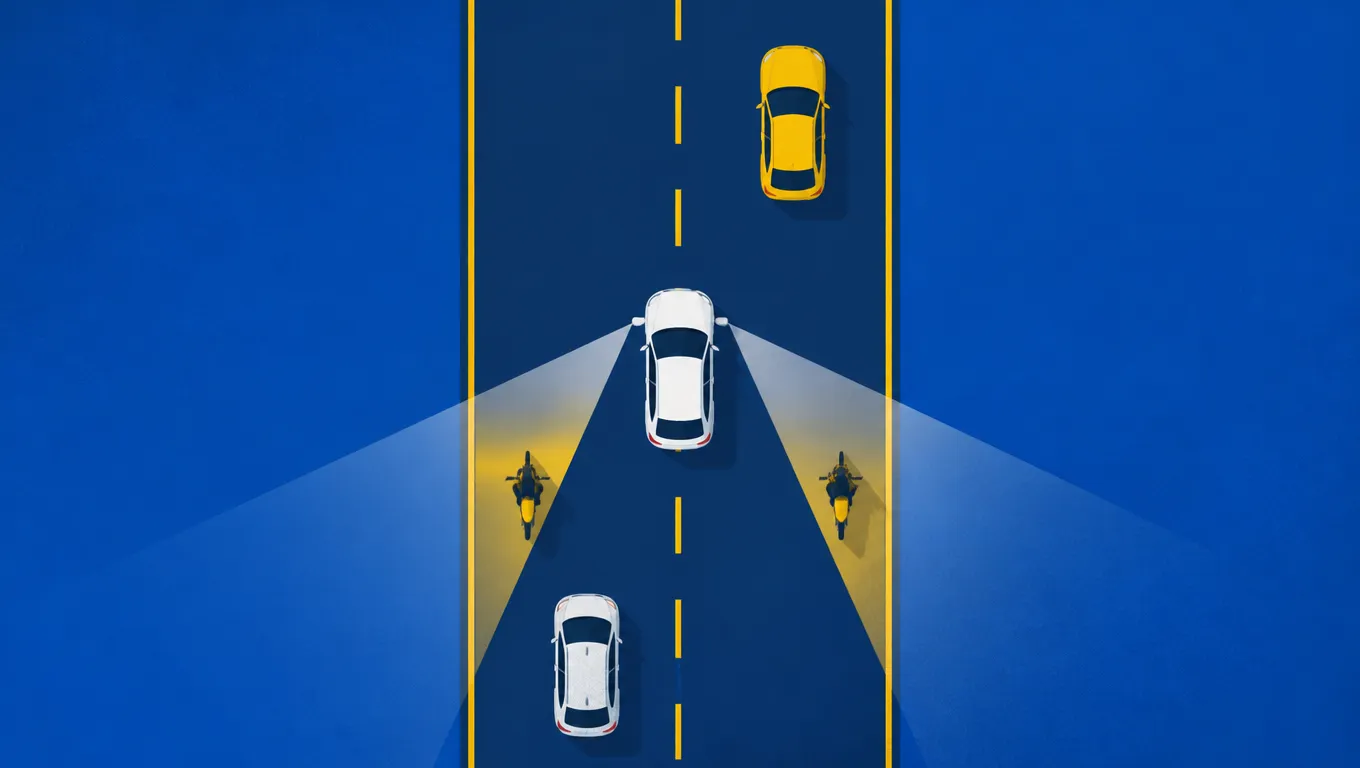
The toter Winkel (blind spot) is the area beside and slightly behind your car that no mirror shows. A cyclist, a motorcycle or even a whole car can be hidden in it. The only way to see there is the Schulterblick (shoulder check): a short look over your shoulder before you move sideways.
Where the toter Winkel is
Your interior mirror shows the road behind you. The exterior mirrors show a strip along each side. Between what the exterior mirror shows and what you see through the side window, there is a gap. It lies next to your rear doors and a little behind them, on both sides.
Example: you want to move one lane to the left. The mirror looks empty. Your shoulder check shows a motorcycle next to your rear door. You stay in your lane.
Narrow and quiet road users hide there most easily: cyclists, e-scooter riders and motorcyclists.
The order: mirrors, signal, shoulder check
Driving schools in Germany teach a fixed order before every move to the side. It is teaching practice, not a wording from the law:
- Interior mirror
- Exterior mirror on the side you move to
- Signal
- Shoulder check
- Move
The law itself asks for the looking. Before a turn you must check the traffic behind you twice: once before you get in lane, and again just before you turn. You may only change lanes or pull out if nobody is endangered.
A few points make the shoulder check work:
- It is a glance, not a long look. Keep the steering wheel straight while you turn your head.
- Do it last, right before you move. A picture that is three seconds old is out of date.
- Set the seat and all mirrors before you start the engine. Well-set mirrors make the blind spot smaller. They do not remove it.
When you need the shoulder check
- Pulling out from the kerb. Look over the shoulder on the road side.
- Changing lanes, also in a zipper merge and when you move back in after overtaking.
- Turning right. Just before you turn, check the right exterior mirror and look over your right shoulder. Cyclists and e-scooter riders who go straight on beside you go first. This holds even when they ride on a path next to the road.
- Turning left. Check behind again just before the turn, in case someone is overtaking you.
- Opening a door. Mirror first, then a look over the shoulder. Tell your passengers to do the same.
Example: you park at the roadside and reach for the door handle. You look in the mirror and over your left shoulder. A cyclist is two seconds away. You wait and open the door afterwards.
One detail explains why the right side matters so much in town. Where there is enough room, cyclists may pass waiting vehicles on the right. A rider you overtook 200 m back may be beside you again at the next red light.
Lorries and buses have much bigger blind spots
Other drivers have a blind spot too. A lorry driver sits high and has no rear window to look through. There are areas the driver cannot see:
- close behind the lorry
- directly in front of it
- beside it, mainly on its right side
What this means for you in a car:
- If you cannot see the lorry’s mirrors, the driver cannot see you.
- Do not drive next to a lorry for long. Pass it without delay or stay behind.
- Never stop beside a lorry that may turn right, and never move into the space on its right while it turns.
- A long lorry may first swing out to the left before it turns right. That is not a change of plan. Do not pass it on the right.
The law puts a duty on the heavy vehicle as well. In built-up areas, drivers of motor vehicles over 3.5 t must turn right at walking pace when they have to expect cyclists going straight on or pedestrians crossing.
Stay out of other people’s blind spots
The same logic works in reverse. On a road with several lanes, do not sit beside and just behind another car for a long time. Its driver may not see you and may move over. Drop back or go past.
After you overtake a cyclist, do not cut in at once. Move back only when you see the rider well behind you. The side distance you need is in the post on overtaking cyclists, and the general rules are in overtaking rules.
Common mistakes
- “The mirror is empty, so the lane is free.” The mirror does not show the area next to your rear doors. Only the shoulder check does.
- “I looked a moment ago.” If you wait after looking, the picture is out of date. Look again right before you move.
- “With the signal on, others have to let me in.” A signal announces what you want to do. It gives you no priority.
- “One look before a right turn is enough.” You need a second look just before turning, in the mirror and over the right shoulder.
- “A glance in the mirror is enough before opening the door.” Cyclists come up fast and quietly. Mirror and shoulder check.
How to remember it
- “Empty mirror does not mean empty road.”
- Around a lorry: no mirror in sight, no driver who sees you.