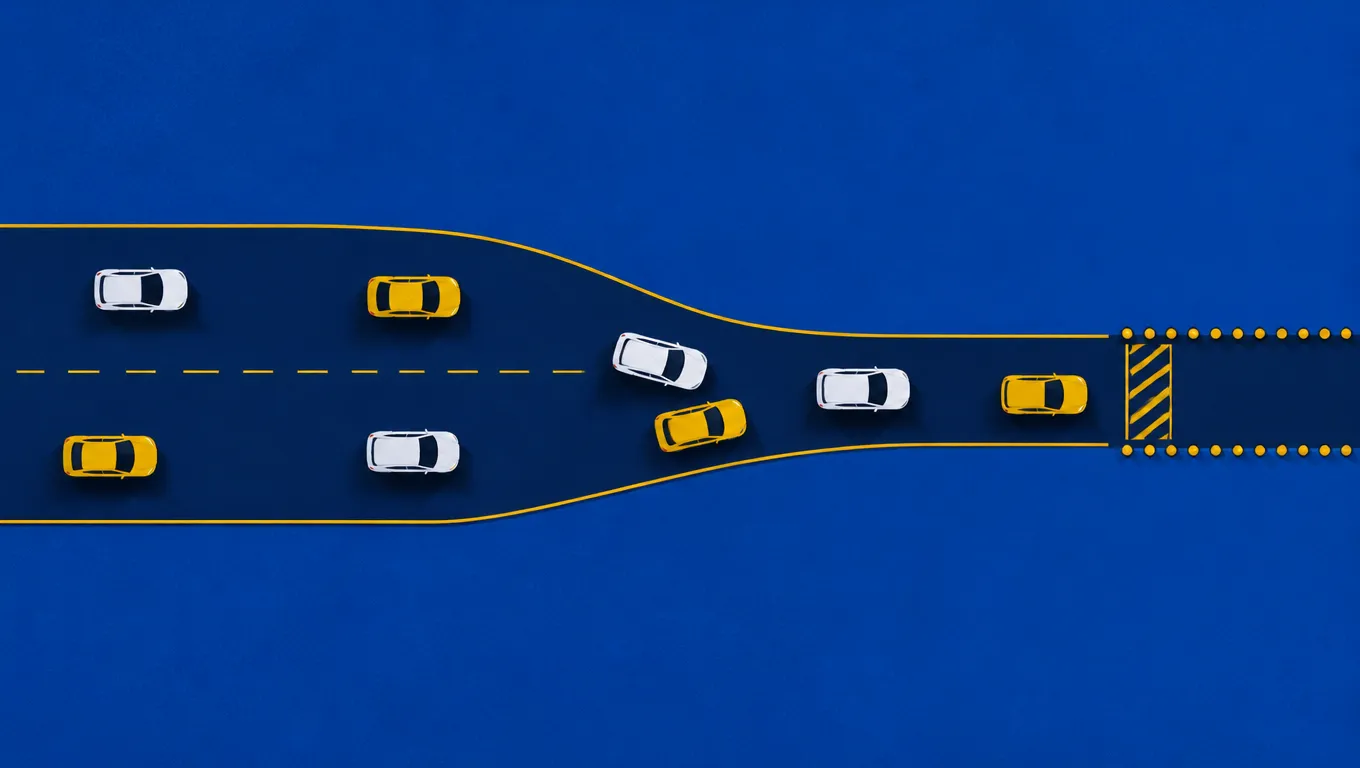
The Reißverschlussverfahren (zipper merge, or zip merge) applies where one of several lanes in your direction ends or is blocked. Vehicles in the closing lane drive right up to the narrowing and merge there. They alternate with the continuing lane: one vehicle from one lane, then one from the other. Drivers in the continuing lane must let them in.
When the Reißverschlussverfahren applies
Two conditions must be met:
- There are at least two lanes for your direction.
- One of them cannot be used any further. It ends, or something blocks it.
Typical cases:
- a lane closed at roadworks
- a road that narrows from three lanes to two, or from two to one
- an accident or a broken-down vehicle standing in one lane
- a parked lorry or a delivery van blocking the right-hand lane in town
The rule is not limited to motorways. It applies on any road with several lanes for one direction, in town as well as outside.
Where to merge: at the end, not before
The law fixes the place: directly before the narrowing. Not 300 metres earlier, where the first sign announces the closed lane.
This feels impolite to many drivers. They move over early and then watch others drive past on the free lane. But the drivers who use the closing lane to its end are following the rule. Merging early wastes hundreds of metres of road and makes the queue in the other lane longer. With both lanes filled up to the narrowing, the road space is fully used and the queue reaches back less far.
So if your lane ends:
- Stay in your lane and drive up to the narrowing at the speed of the traffic.
- Signal in time.
- Check the mirror and the blind spot. See blind spot and shoulder check.
- Merge into the gap behind the vehicle that is level with you or just ahead.
Who goes when
The order is strictly alternating. One vehicle from the continuing lane, one from the closing lane, and so on.
A worked example. The right lane ends at roadworks. Car B is in the left lane, slightly ahead of you. You are in the right lane, at the narrowing. Car C is in the left lane behind B. B drives through first. You merge behind B. C lets you in and follows you. The vehicle behind you in the right lane then merges behind C.
Each driver in the continuing lane lets in exactly one vehicle. Nobody has to let in three, and nobody from the closing lane may push in as the second in a row.
What each lane owes the other
In the continuing lane: letting one vehicle merge is a duty, not a favour. Leave a gap as you approach the narrowing. Do not close up to the car in front to keep someone out. Do not straddle both lanes to stop others driving past.
In the closing lane: the zipper merge does not hand you a right of way that you can force. The general rule for changing lanes still applies. You may change lanes only if no other road user is endangered, and you must signal in time. If the driver next to you does not open a gap, you wait at the narrowing for the next one. You do not squeeze in.
Both sides need the other. That is why the merge works best at low, even speed, with eye contact where possible.
Where the zipper merge does not apply
Joining a motorway. The acceleration lane at a motorway entry is not a lane that ends in the sense of this rule. Traffic on the through lanes has priority. According to ADAC, the driver joining is responsible for merging correctly. You use the acceleration lane to reach the speed of the traffic and move into a gap. If there is no gap, you wait at the end of the lane. Drivers on the motorway may make room by moving left if that endangers nobody, but they do not have to. More in Autobahn rules.
An obstacle on a road with one lane each way. If a parked car blocks your side and you need the oncoming lane to pass it, a different rule applies. You let oncoming vehicles through first.
An ordinary lane change. If both lanes continue and you simply want to be in the other one, nobody has to let you in.
Common mistakes
- “Merging early is the polite thing to do.” It makes the jam longer. Use your lane to its end and merge directly before the narrowing.
- “Drivers who pass me on the closing lane are queue jumpers.” They are doing what the rule asks. Let one of them in at the front.
- “I block the closing lane to teach them a lesson.” That is not your job, and it stops the merge from working.
- “My lane ends, so the others must brake for me.” They must let you in one at a time, but you may not endanger anyone when you move over.
- “The zipper merge applies at the motorway entry.” It does not. The through lanes have priority there.
How to remember it
A zip closes at the end, tooth by tooth. Not halfway up, and never two teeth from the same side.