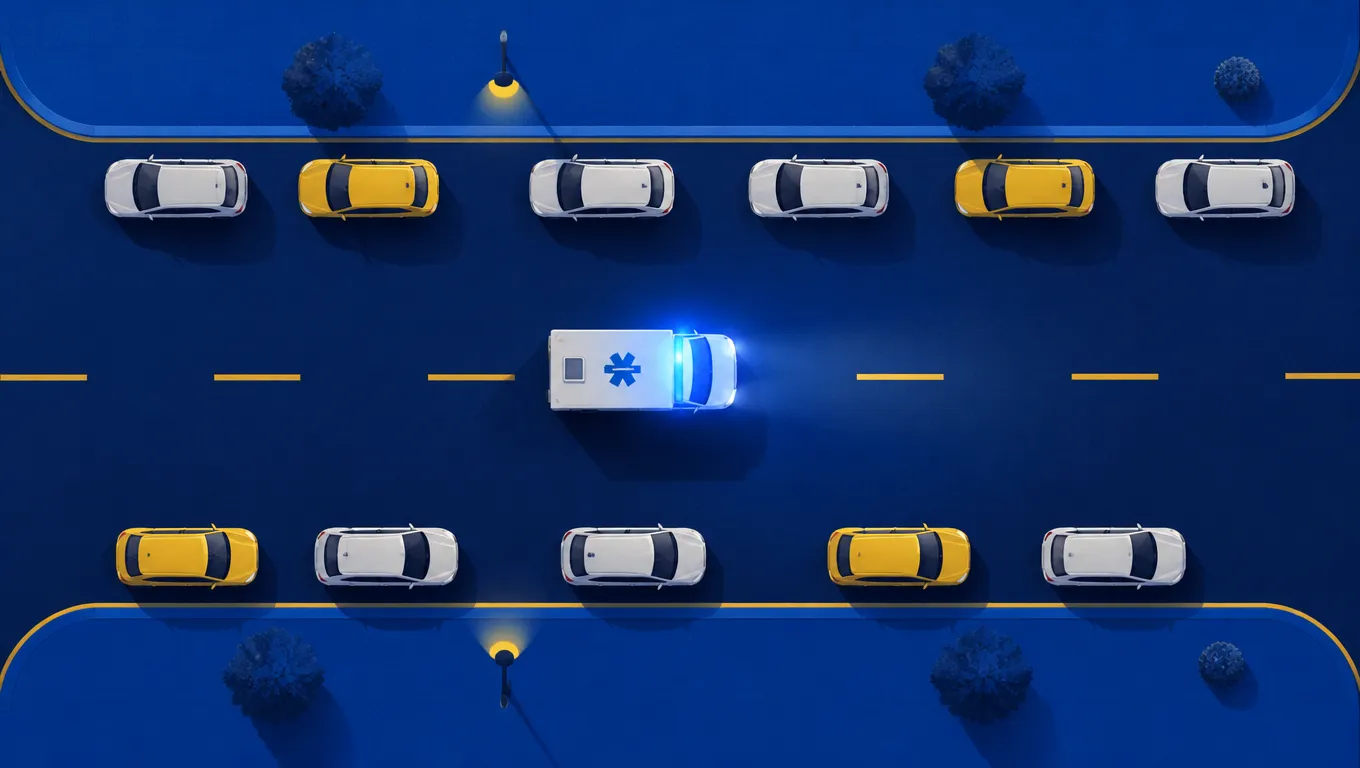
The Blaulicht Martinshorn Regeln (rules for blue light and siren) come down to one sentence in the road traffic regulations: when a vehicle uses blue flashing light together with its siren, all other road users must clear the way at once. This applies even if your light is green or you are on a priority road. How you clear the way depends on where you are.
What the signals mean
German emergency vehicles carry a blue flashing light (Blaulicht) and a siren, officially the Einsatzhorn and in everyday speech the Martinshorn. The law treats three signals differently.
| Signal | Meaning for you |
|---|---|
| Blue light with siren | Make way immediately. This beats lights, signs and your priority. |
| Blue light alone | A warning. It is used at accident and operation sites, on emergency runs and to escort vehicles or convoys. Slow down and take care. |
| Yellow flashing light | Warns of a danger, for example a work site, a very slow vehicle or an oversized load. It gives nobody priority. |
Blue light and siren together may only be used when the matter is extremely urgent: to save life, to prevent serious harm to health, to avert a danger to public safety, to pursue someone who is fleeing, or to protect property of great value.
Police, fire brigade, ambulances and some other services also have special rights. When their task makes it urgently necessary, they are exempt from the traffic rules. They may then drive through red lights and exceed speed limits, with due regard for public safety. So expect an emergency vehicle to come from a direction and at a speed that the rules would not normally allow.
The Blaulicht Martinshorn Regeln in practice
The law says what you must achieve, a free path, and not how. ADAC’s advice is to pull over as far right as you can and either stop there or roll on slowly, depending on the traffic and the place. In town, moving left into a turning lane can sometimes be the better way.
A sensible order when you hear a siren:
- Find it. Turn the music down. Check the mirrors and look ahead and to the sides. Where is the vehicle coming from, and where does it want to go?
- Slow down. Do not brake sharply. The driver behind you may not have noticed anything yet.
- Signal. Show the emergency driver and the cars around you which way you are moving.
- Move aside and, if needed, stop. Do it in a way the emergency driver can predict.
- Wait. After the first vehicle, look again. Fire engines and ambulances often come in groups.
Stay calm. A panic stop in the middle of the lane blocks the road as well as driving on does.
At a junction or a red light
If the emergency vehicle comes from a side road or from ahead, stay out of the junction and leave it clear, even at green.
If it comes from behind and you are waiting at a red light, the cars in front may have to make room. According to ADAC, when the path cannot be cleared any other way, you may exceptionally edge forward carefully past the red light into the junction. Go only as far as is needed, watch the cross traffic and pedestrians, and stop again.
On the motorway
On motorways, and on roads outside towns with at least two lanes in one direction, there is a fixed rule. As soon as traffic slows to walking pace or stops, vehicles form an emergency corridor between the far-left lane and the lane next to it. You form it before any siren can be heard. The details are in Rettungsgasse.
What you must not do
- Do not follow an emergency vehicle through the gap it has opened.
- Do not stop next to another stopped car so that the two of you close the road.
- Do not ignore a siren because your light is green. See which right-of-way rule wins.
If a police car with blue light stays behind you and signals you to stop, that is a traffic stop. Pull over where it is safe. More on police signals in police hand signals.
What it costs
As of November 2026, the catalogue of fines lists these amounts for not clearing the way at once for a vehicle with blue light and siren:
| Offence | Fine | Driving ban |
|---|---|---|
| Did not make way immediately | 240 euros | 1 month |
| With endangerment | 280 euros | 1 month |
| With damage to property | 320 euros | 1 month |
Common mistakes
- “I have green, so I drive.” Blue light with siren beats a green light and a priority sign. Make way at once.
- “Blue light without a siren means the same.” Only both together create the duty to clear the way. Blue light alone warns you, and you still slow down and take care.
- “I stop exactly where I am.” That can block the road. Move aside first, then stop.
- “I must never cross a red light, whatever happens.” If there is no other way to let the vehicle through, you may carefully edge forward.
- “One ambulance has passed, so it is over.” More vehicles often follow. Look again before you pull back out.
How to remember it
Blue and loud beats everything, including your green.
For the sequence: find it, slow, signal, move, wait.