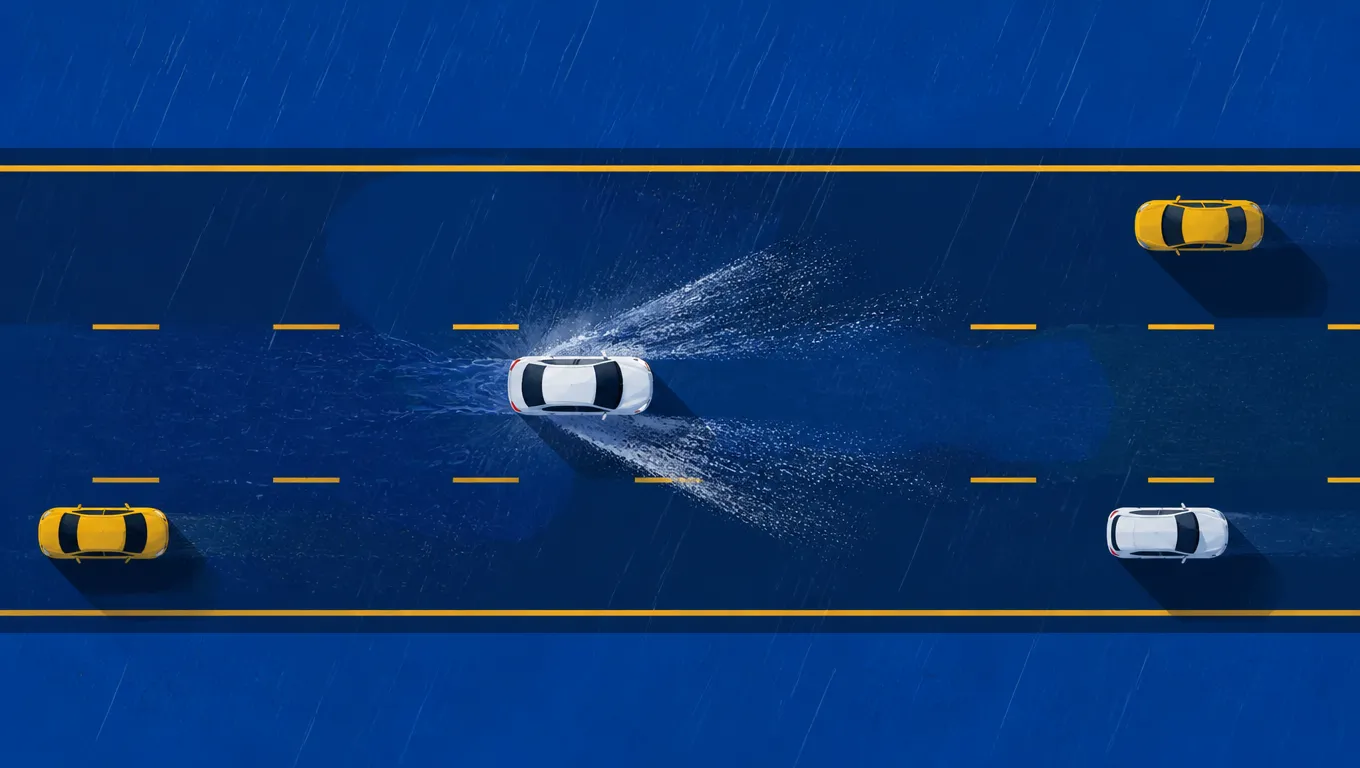
Aquaplaning happens when the tyres float on a layer of water and lose contact with the road. The car can then neither be steered nor braked. The right reaction is short: foot off the accelerator, clutch down, hold the steering wheel straight, do not brake, and wait until the tyres grip again.
Why aquaplaning happens
On a wet road the tyre tread has a job. Its grooves push the water aside so that the rubber touches the road surface. This works up to a point. If there is too much water, or the car is too fast, the tread cannot move the water away quickly enough. A wedge of water builds up in front of the tyre and lifts it off the road.
From that moment the tyre slides on water. It cannot pass on steering or braking forces. German uses the same word, Aquaplaning.
Three things raise the risk:
- Speed. The faster you drive, the less time the tread has to clear the water.
- Depth of the water. Standing water is the problem, not a road that is merely damp.
- Worn tread. Shallow grooves carry less water away. Tyres near the legal minimum of 1.6 mm float much earlier than new ones.
Tyre pressure plays a part too. Good tread and correct pressure push the water away better.
Where and when to expect it
Water collects where it cannot run off. Typical places are:
- lane ruts worn into the surface by heavy traffic
- dips and hollows
- underpasses
The warning sign for a slippery road (Schleudergefahr bei Nässe oder Schmutz) shows a car with curved skid marks. Where it stands, expect less grip in rain.
Heavy rain is the obvious trigger. Remember also that the first rain after a long dry spell makes the road especially slippery, even without deep water.
How to notice that the car is floating
Aquaplaning announces itself. The usual signs are:
- The steering suddenly feels light and the car no longer follows it.
- The engine revs rise, because the driven wheels spin without resistance.
- The noise of water under the car gets loud.
If you notice one of these on a wet road, act at once.
What to do when aquaplaning starts
Stay calm. What you do while the car floats decides how it ends.
- Take your foot off the accelerator.
- Press the clutch.
- Hold the steering wheel straight.
- Do not brake and do not steer.
- Wait until the tyres touch the road again.
In an automatic car there is no clutch to press. You ease your foot off the accelerator and leave the selector where it is.
The reason for holding the wheel straight is what happens next. When the tyres find the road again, they grip at once. If they point in the direction the car is moving, the car stays stable. If they are turned, or braked, the sudden grip jerks the car sideways. Drivers who steer towards the edge of the road while floating are often thrown off line the moment grip returns.
After it is over, drive on more slowly. Where there was one puddle, the next is likely.
How to prevent it
You cannot steer or brake your way out of aquaplaning. You can only avoid getting into it.
- Reduce speed clearly in heavy rain, and do it before you reach standing water, not in it.
- Check the tread. The law requires at least 1.6 mm, but grip on wet roads gets worse long before that. Experts often advise changing summer tyres at about 3 mm.
- Check the tyre pressure regularly, on cold tyres.
- Keep a larger gap to the vehicle ahead. On a wet road the braking distance is much longer than the rule of thumb says, and spray cuts your view.
- Do without cruise control on a wet road. No assistance system knows how slippery the surface is.
A speed limit is the maximum for good conditions. In a downpour the safe speed can be far below the number on the sign. More on that in the overview of speed limits in Germany.
Common mistakes
- “If the car floats, I brake hard.” While the tyres float, braking does nothing. When grip returns, braked wheels throw the car off line.
- “I steer against it or towards the edge.” Steering has no effect on water. Turned wheels jerk the car sideways when they grip again. Hold the wheel straight.
- “ABS, ESP or four-wheel drive protect me.” These systems work only as far as the tyres have grip. A floating tyre has none.
- “My tyres are legal, so I am safe.” 1.6 mm is the legal minimum, not a safety margin. Tyres at that depth float much earlier.
- “The limit is 100 km/h, so 100 km/h is fine in rain.” The limit is a ceiling for good conditions. Standing water calls for much less.
How to remember it
“Feet off, wheel straight, wait for grip.” Off the accelerator, clutch down, no brake, no steering.
For prevention, one line is enough: slow down before the water, not in it.