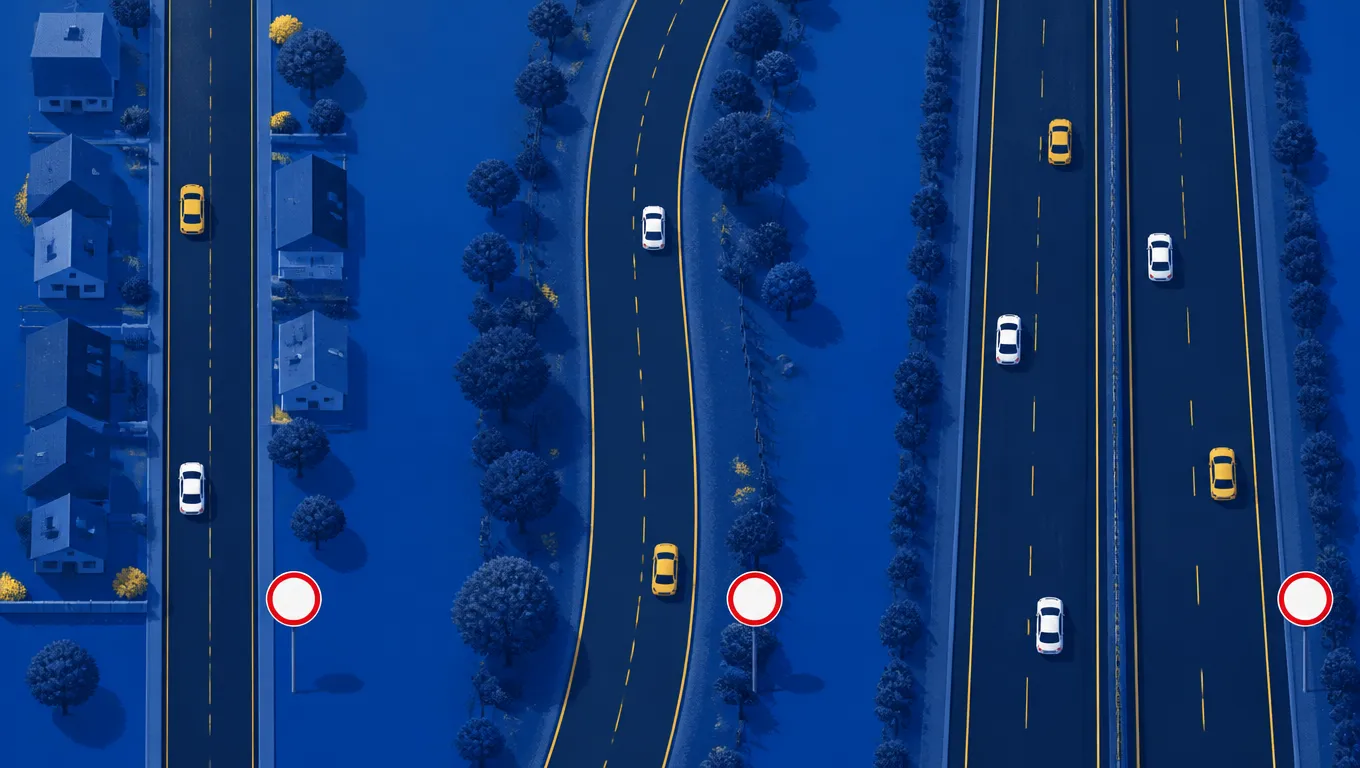
The general speed limit in Germany for a car is 50 km/h in town and 100 km/h outside town. On the motorway (Autobahn) there is no general limit for cars, only a recommended speed of 130 km/h. These values apply without any sign, and a sign can always set something else.
Speed limit Germany: the general limits at a glance
| Where | Car up to 3.5 t | Car with trailer |
|---|---|---|
| In town (innerorts) | 50 km/h | 50 km/h |
| Outside town (außerorts) | 100 km/h | 80 km/h |
| Motorway (Autobahn) | no general limit, 130 km/h recommended | 80 km/h (100 km/h only with a special approval for the combination) |
| Any road, visibility under 50 m | 50 km/h | 50 km/h |
Heavier vehicles such as lorries and buses have lower limits outside town. This post covers cars.
In town: 50 km/h from sign to sign
Inside towns and villages the limit is 50 km/h for all motor vehicles. It starts at the yellow sign with the name of the place (Ortstafel). It ends at the town end sign, which shows the name crossed out in red. No separate speed sign is needed.
Two typical errors happen at these signs. Drivers speed up when the houses end, although the town end sign has not come yet. Or they keep country road speed after they have passed the yellow sign. The signs decide, not the houses.
Signs can set a lower limit. The most common case is the 30 zone (Tempo-30-Zone). In a traffic-calmed area you drive at walking pace. The post on the verkehrsberuhigter Bereich covers that.
Outside town: 100 km/h for cars
Outside towns, cars and other vehicles up to 3.5 t may drive 100 km/h at most. A car with a trailer may drive 80 km/h at most.
The 100 km/h limit is a ceiling, not the normal speed for every country road. Country roads have bends, crests, junctions, trees and oncoming traffic. You slow down before a bend or a crest, and then you steer.
Autobahn: no general limit, 130 km/h recommended
On motorways the 100 km/h limit does not apply. The same is true outside town for roads with separate carriageways for each direction, and for roads with at least two marked lanes per direction. On these roads cars have a recommended speed (Richtgeschwindigkeit) of 130 km/h.
Recommended means advice. It is not a limit and not a minimum. Many stretches have a limit by sign, and that limit is binding. The post on Richtgeschwindigkeit and Autobahn rules goes into detail.
Limits that depend on the conditions
Some limits come from the situation, not from the type of road.
- Visibility under 50 m. If fog, falling snow or rain cuts your view to less than 50 m, you may drive 50 km/h at most. This applies on every road, including the motorway. If you see even less, you drive slower still.
- Snow chains. With snow chains fitted, the maximum is 50 km/h.
- Driving on sight. You must always be able to stop within the distance you can see. On roads so narrow that oncoming traffic could be endangered, within half of that distance.
A quick way to judge 50 m: the marker posts at the roadside normally stand 50 m apart. If you can see only one post ahead, your view is about 50 m.
German law also puts one rule above all the numbers: a limit is a maximum, not a target. You may only drive so fast that you keep the car under control at all times. You adapt your speed to the road, the traffic, the visibility and the weather. Your own skills, the car and its load count as well.
An example: the sign allows 100 km/h. It rains hard, the road winds through a forest and wet leaves lie on it. The right speed may be 60 km/h. The stopping distance shows why: braking distance grows with the square of the speed.
The opposite also applies. A motor vehicle must not drive so slowly, without a good reason, that it holds up the traffic.
What speeding leads to
The fines depend on how far you are over the limit and whether you are in town or outside. As of November 2026, ADAC gives these markers for the points register: a car that is 21 km/h over the limit gets 1 point. From 31 km/h over in town, or 41 km/h over outside town, the offence counts as serious and brings 2 points.
For new drivers there is more. Speeding by 21 km/h or more counts as a serious offence in the Probezeit. One such offence brings a seminar and two more years of probation.
Common mistakes
- “The limit is the speed I should drive.” The limit is the most that is allowed in good conditions. Rain, bends, darkness or traffic often call for much less.
- “130 km/h is the Autobahn limit.” It is a recommendation for good conditions. Where a sign sets a limit, the sign applies.
- “With a trailer I can drive 100 km/h outside town.” The limit for a car with a trailer is 80 km/h.
- “The fog rule does not apply on the motorway.” Under 50 m of visibility the maximum is 50 km/h on every road.
- “The driver behind is pushing, so I must speed up.” Only the conditions set your speed. Pressure from behind is no reason.
How to remember it
The round numbers go up in steps: 50 in town, 100 outside, 130 recommended on the Autobahn.
For fog there is a pair that matches: 50 m view, 50 km/h.