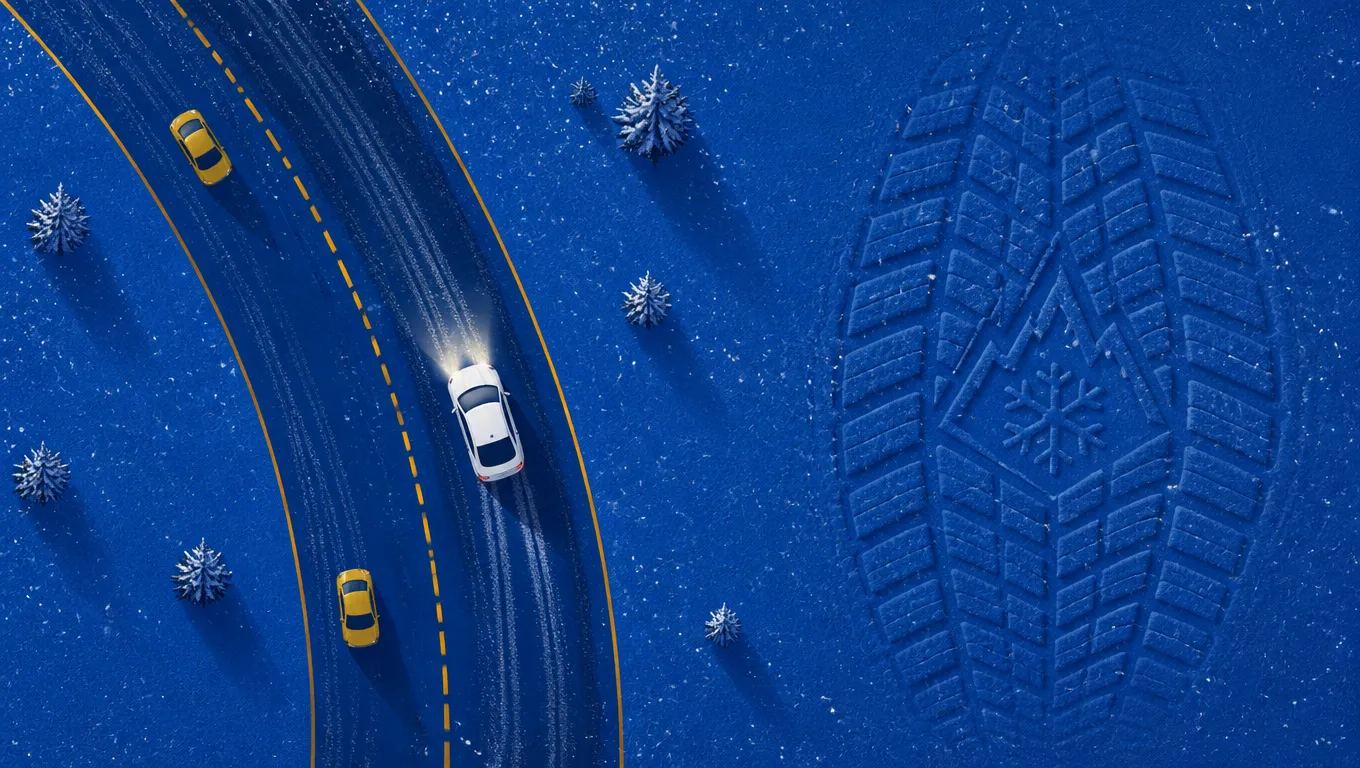
Germany has no fixed winter tyre season. The Winterreifenpflicht (winter tyre duty) depends on the road: on black ice, packed snow, slush, ice or frost you may drive only with winter tyres on all wheels. Winter tyres are tyres with the Alpine symbol, a mountain with three peaks and a snowflake.
When the Winterreifenpflicht applies
The law names five road conditions:
- black ice (Glatteis)
- packed snow (Schneeglätte)
- slush (Schneematsch)
- ice (Eisglätte)
- frost (Reifglätte)
If the road is in one of these states, the rule applies. The month does not matter. It can apply in October or in April, and on a dry, clear January day it does not.
Because of this, lawyers call it a situational duty (situative Winterreifenpflicht). It is a rule about driving. If your car has summer tyres and the roads are wintry, you leave the car where it is.
For cars, all four wheels need winter tyres. Motorcycles and other single-track motor vehicles are exempt.
Which tyres count
A tyre counts as a winter tyre if it carries the Alpine symbol (Alpine-Symbol): a mountain with three peaks and a snowflake inside.
- Winter tyres with the symbol: yes.
- All-season tyres with the symbol: yes.
- Tyres marked only M+S: no longer. Older M+S tyres made before 2018 were accepted for a transition period. That period ended on 30 September 2024.
Many tyres carry both M+S and the Alpine symbol. Those are fine. Look for the symbol on the side of the tyre.
The rule also applies to cars with foreign number plates. If you bring a car into Germany or hire one, check the tyres before a winter trip. More basics for new arrivals are in driving in Germany: rules for newcomers.
Tread depth
The legal minimum tread depth for every tyre is 1.6 mm in the main grooves, all the way round. That is the limit of the law, not a target. A winter tyre works through its tread and its soft rubber, and both get worse with wear and age, so do not run it down to the limit.
What a violation costs
Standard penalties, as of November 2026:
| Offence | Fine | Points |
|---|---|---|
| Driving on a wintry road without winter tyres | 60 euro | 1 |
| The same, and you hinder others | 80 euro | 1 |
| The same, and you endanger others (according to ADAC) | 100 euro | 1 |
| Keeper who orders or allows such a drive | 75 euro | 1 |
The last line matters when you lend your car or own a car that others drive. The keeper (Halter) answers for the tyres too, not only the driver.
October to Easter is a habit, not the law
Many drivers in Germany fit winter tyres from October to Easter. People call this “von O bis O” (Oktober bis Ostern). It is a rule of thumb. It is useful because the first frost often comes without warning and workshops are full in the first cold week. It is not the law.
So two things are true at the same time:
- You may drive on summer tyres in December if the road is dry and free of ice.
- You may not drive on summer tyres in late October if there is slush on the road.
Winter tyres do not change physics
Winter tyres give more grip on snow and ice than summer tyres. They do not give you the grip of a dry road. On snow the braking distance is still much longer than normal. The rule of thumb for dry roads is in the post on the braking distance formula, and on a slippery road you need far more than that.
- Drive slower and keep a much larger gap.
- Brake, steer and accelerate gently.
- In wintry conditions the washer fluid needs antifreeze as well.
Water and slush can also lift the tyres off the road. See aquaplaning: what to do.
Common mistakes
- “Winter tyres are required from a certain date.” There is no date. The state of the road decides.
- “If I drive slowly, summer tyres are legal on snow.” Slow driving does not replace the tyres. On wintry roads the car stays parked.
- “M+S on the tyre is enough.” Since October 2024 only the Alpine symbol counts.
- “All-season tyres are not allowed in winter.” They count if they carry the Alpine symbol.
- “Only the driver gets fined.” The keeper who allows the drive pays too.
How to remember it
- The road decides, not the calendar.
- Mountain plus snowflake: no symbol, no winter tyre.